Setup And Overview
Kotlin DataFrame Compiler Plugin is a Kotlin compiler plugin that automatically generates
type-safe extension properties for your dataframes,
allowing you to access columns and row values in a type-safe way and avoid mistakes in column names.
Why use it?
Access columns as regular properties:
df.nameinstead ofdf["name"].Get full IDE and compiler support: autocompletion, refactoring, and type checking.
Improve code readability and safety when working with DataFrame.
Check out this video that shows how expressions update the schema of a dataframe:
Setup
We recommend using an up-to-date IntelliJ IDEA and Kotlin version for the best experience. Requires at least versions 2025.2 and 2.2.20, respectively.
Set up the plugins in build.gradle.kts:
Setup library dependency:
If you're using a version older than Kotlin 2.4.0, incremental compilation must be disabled due to this issue,
Add the following line to your gradle.properties file:
Sync the project. This is not needed anymore from Kotlin 2.4.0+.
See Setup Kotlin DataFrame in Gradle and Custom Gradle Configuration for more details.
The DataFrame compiler plugin can be used in Maven projects starting from IntelliJ IDEA 2025.3, available now as EAP builds
Update the <kotlin-maven-plugin> in the <plugin> section of your pom.xml:
Setup library dependency:
Sync the project.
See Setup Kotlin DataFrame in Maven for more details.
The DataFrame compiler plugin can be used with Kotlin Toolchain starting from Kotlin Toolchain 0.12.0+ and IntelliJ IDEA 2026.2.1+.
Update the settings: block in your module.yaml file as follows:
Doing so will enable the compiler plugin matching the Kotlin version. It will also automatically add the latest (1.0.0-rc02) dataframe-core dependency to your project.
In contrast to Maven and Gradle projects, this does NOT include any IO dependencies.
See Setup Kotlin DataFrame in Kotlin Toolchain for more details about this.
If you want a specific version of the DataFrame library, you can do that in the settings.kotlin.dataframe: block:
Features overview
Static interpretation of DataFrame API
The plugin evaluates dataframe operations, given compile-time known arguments such as constant String, resolved types, property access calls. It updates the return type of the function call to provide properties that match column names and types. The goal is to reflect the result of the operations you apply to a dataframe in types and have a convenient typed API:
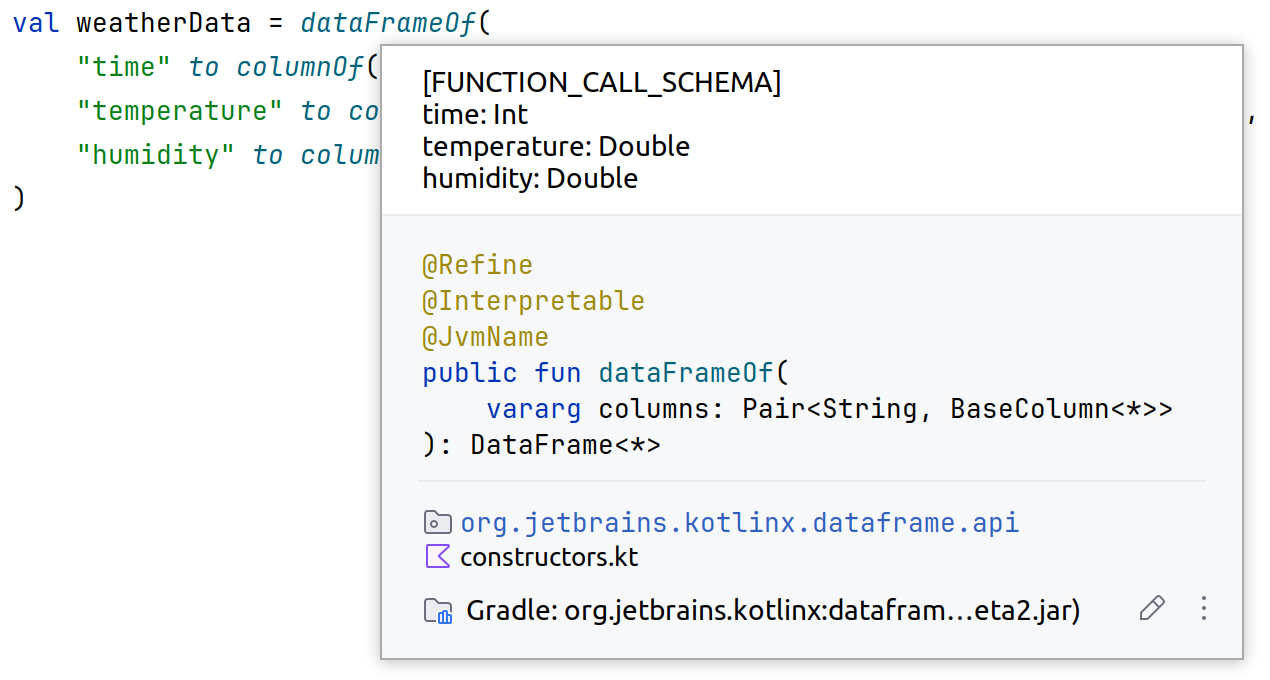
The schema of DataFrame, as the compiler plugin sees it, is displayed when you hover on an expression or variable:
@DataSchema declarations
An untyped DataFrame can be assigned a data schema — a top-level interface or data class that describes the names and types of the columns in the dataframe.
Learn more about data schema declarations
Examples
Kotlin DataFrame in the IntelliJ IDEA Gradle project example
— an IntelliJ IDEA Gradle project showcasing simple DataFrame expressions using the Compiler Plugin.Kotlin DataFrame in the IntelliJ IDEA Maven project example
— an IntelliJ IDEA Maven project showcasing simple DataFrame expressions using the Compiler Plugin.Kotlin DataFrame in the IntelliJ IDEA Kotlin Toolchain project example
— an IntelliJ IDEA Kotlin Toolchain project showcasing simple DataFrame expressions using the Compiler Plugin.Compiler Plugin Examples — a few examples of Compiler Plugin usage.